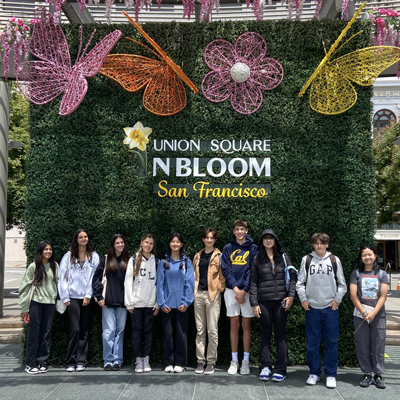
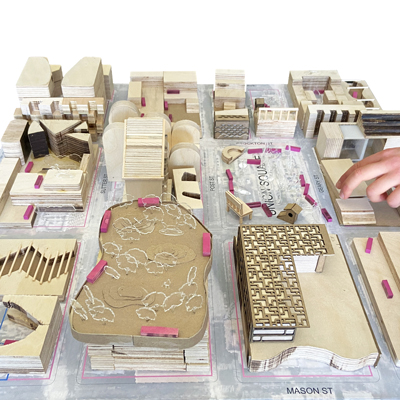
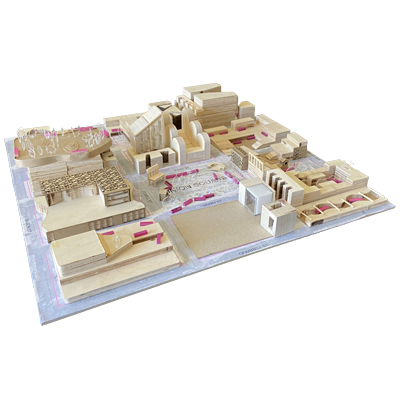
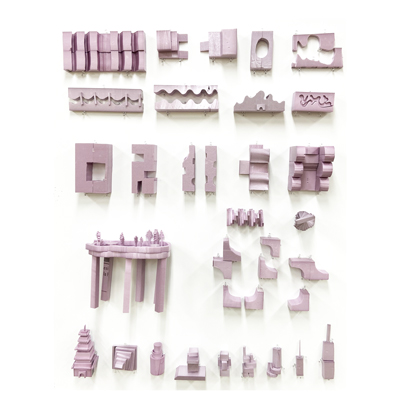
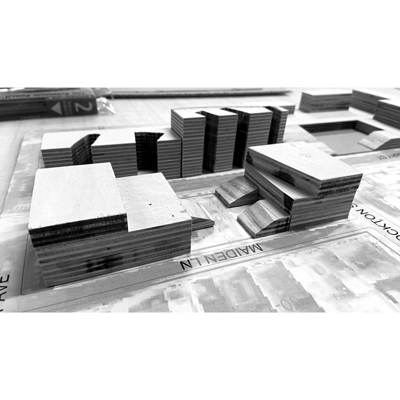
Over the course of two weeks, high school students proposed ideas for increasing foot traffic to the Union Square area based on a critique of current zoning. They then created a board game to compare different urban design strategies such as urban rooms, active street walls, mid-block alleys.
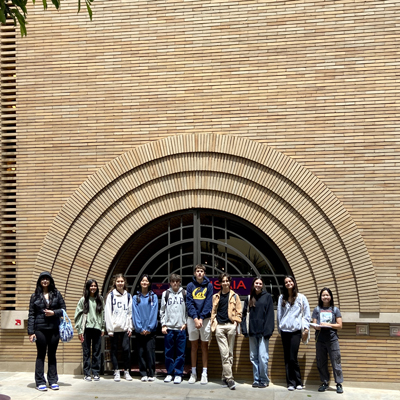
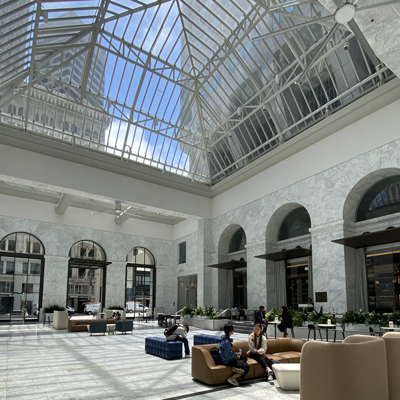
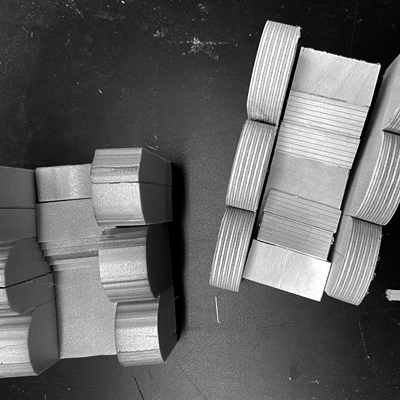
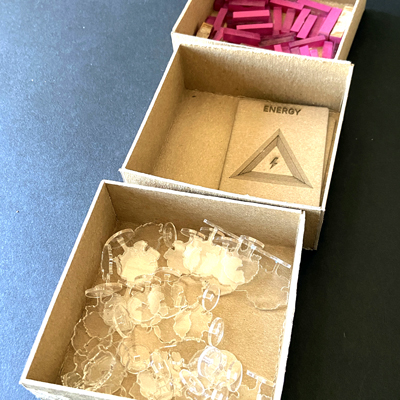
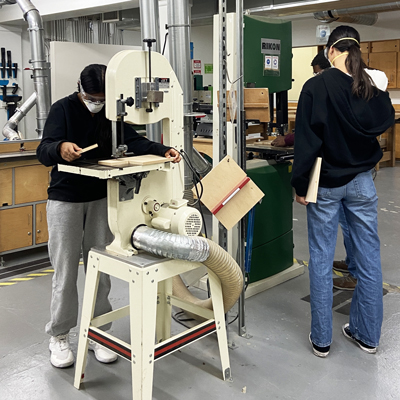
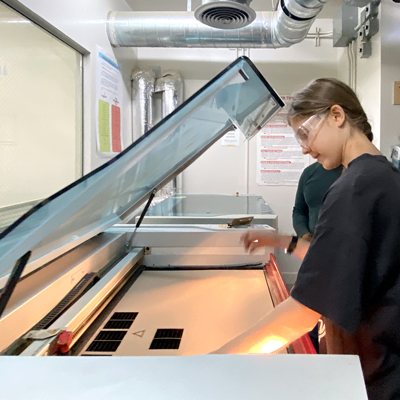
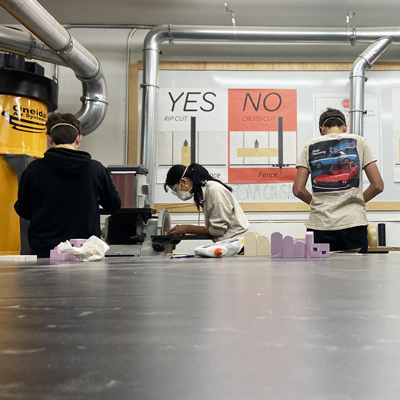
In the Architecture and the City class, students learned about Urban Design concepts and principles through field trips, role plays, videos, and lectures. Through discussions, the class incorporated Urban Design strategies into the board game rules. In the Architecture Maker Lab class, students fabricated the game pieces using wire cutters, band saws, sanders, and laser printers. Through subtractive model making methods, students explored different ways to create Urban Rooms.
“Urban voids were also an interesting topic in this class. I never thought about taking away to create something. Realizing that negative space is just as important as building helped me think of new designs for my game piece, like cutting into the wood to make space.” – Alissa
ACSA Conference Submission co-authored by faculty Sameena Sitabkhan and ARH 498 students Kim Ebueng, Lowai Ghaly, Mazen Ghaly, Andrew Hart, Mohamed Meawad, Kenny Soriano
Keywords: co-creation, micro-intervention, unhoused families, family shelter, community school
Micro-interventions can powerfully disrupt the systems that preclude an empowering experience in family shelters. Through co-creation, families can actively participate in the design research process. Valuing lived experiences of unhoused families removes the power imbalance between those with and without design training. Co-creation at the micro-scale prepares architecture students with skills to usher in change in the design practice.
EMERGENCY CONGREGATE FAMILY SHELTER The Stay Over Program is an emergency congregate family shelter located in the gym of the Buena Vista Horace Mann K-8 Community School (BVHM) in San Francisco. The shelter’s 69 beds comprise 79% of all available congregate family shelter beds in SF.1 Congregate shelters are used as a last resort for families when there is no other temporary housing option available.
Stay Over Program Shelter at BVHM School
The number of unsheltered families fluctuates, so an estimate is based on a Point-in-Time (PIT) count. Conducted every two years using the HUD criteria, the count includes people in shelters, cars, and sleeping rough. The most recent PIT count was conducted on 2/23/2022 between 8pm and 12am. On this night, 7,754 people were counted of which 605 people were in families. Seventy-eight people in families were found to be unsheltered.2
SFUSD counts its unhoused students using a broader criterion, the McKinney-Vento Act, a federal law.3 The total count includes families temporarily staying with another family, living in homes without power or water or heat, in shelters, in weekly rate housing or motels, in abandoned buildings, cars, trailer park, campground, or on the streets. In 2022, there were 2,370 students experiencing homelessness.4
Stay Over Program Shelter Set Up
FAMILY SHELTER AT COMMUNITY SCHOOL At the BVHM Community School, social workers connected behavior issues in three kindergarteners with their stays in congregate shelters for the general population.5 To support unhoused families at the school, the Stay Over Program was created in 2018 as an emergency family shelter. The non-profit shelter operator, Dolores Street Community Services (DSCS), worked closely with BVHM to create a warm and supportive culture leveraging the shared commonality of parents with school-aged children and their familiarity of the school grounds. The emergency shelter filled an unmet need at the community school to provide wrap-around services to meet the basic needs of the families.
NEED FOR MICRO-INTERVENTIONS San Francisco public school capital improvements are frequently delayed by several years even after funding is approved. BVHM facilities are a century old and in dire need of improvements.6 In 2022, the school received $40 million in funding and construction was projected to be complete by the end of 2025.7 The schedule has been revised since with a new completion date of 2028.8
Evening Timeline and Space Usage
In the meanwhile, families with children sleep in the emergency shelter in less-than-ideal conditions each night. Improving the conditions is urgent as it impacts vulnerable young children during their critical developmental years. Micro-interventions, nimble and fast-paced, can leverage available resources to bring relief on a timeline of months.
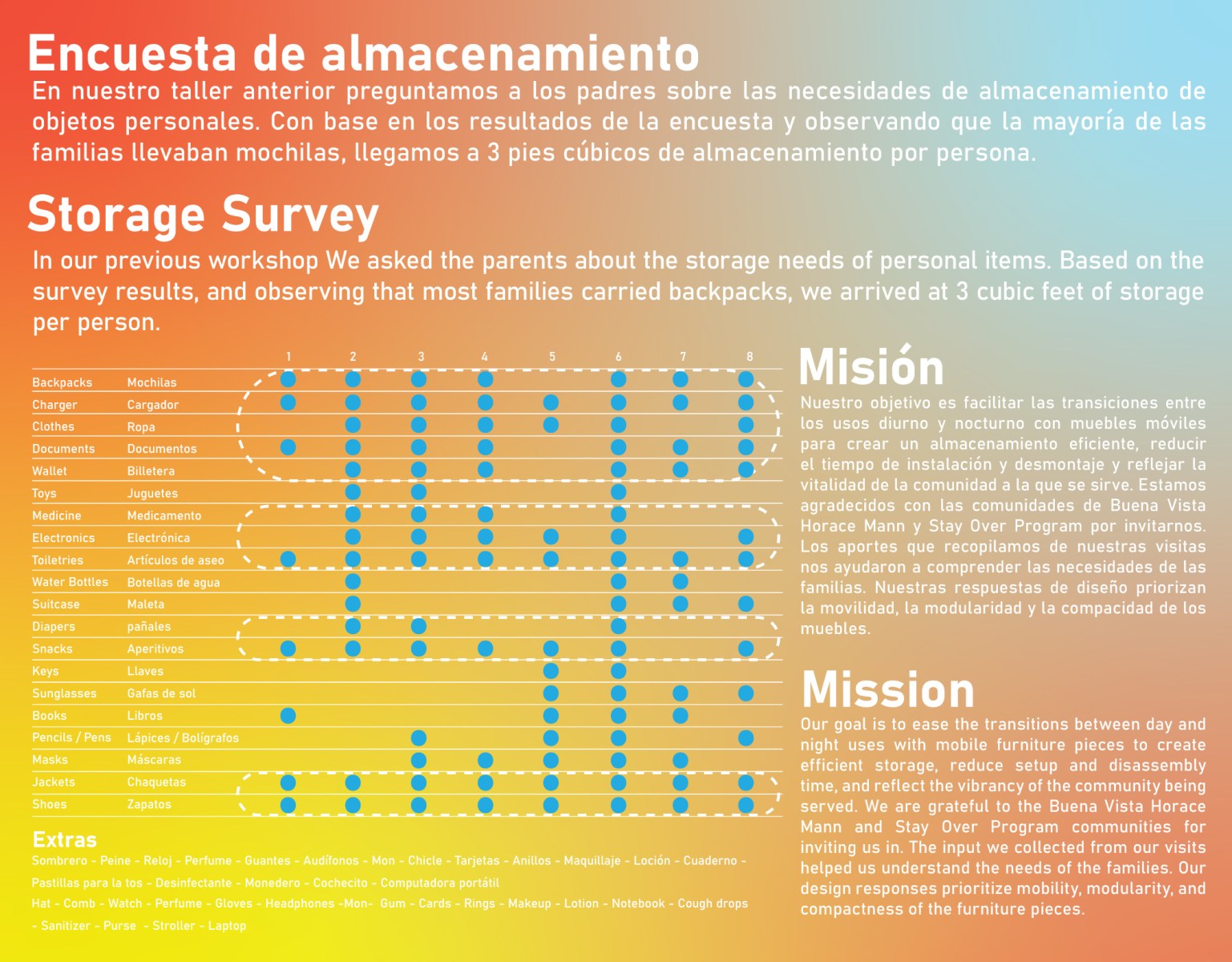
Survey on Storage Needs
WHAT NOT TO DESIGN / WHAT TO DESIGN In 2023, we started a co-creation process to test how microinterventions can empower families, bring design identity to the shared spaces, and remove pain-points in the operations. Operationally, the dual use of the school gym is challenging. During the day the gym is used for PE classes and at night it is used as a shelter. The daily set up and break-down of beds is labor intensive. In addition, a severe lack of storage means that families must leave the shelter each morning and return each evening with their suitcases.
Additionally, the Stay Over Program, the most innovative component of this Community School, stays hidden from the day users of the space. The lack of visibility isn’t representative of the deep sense of community among the families.
In the absence of a design brief, we began with observations at the shelter paralleled with research on design constraints. The project scope was defined by asking what to design as well as what not to design. Physical renovations were quickly ruled out due to asbestos abatement issues.
Fabrication Process
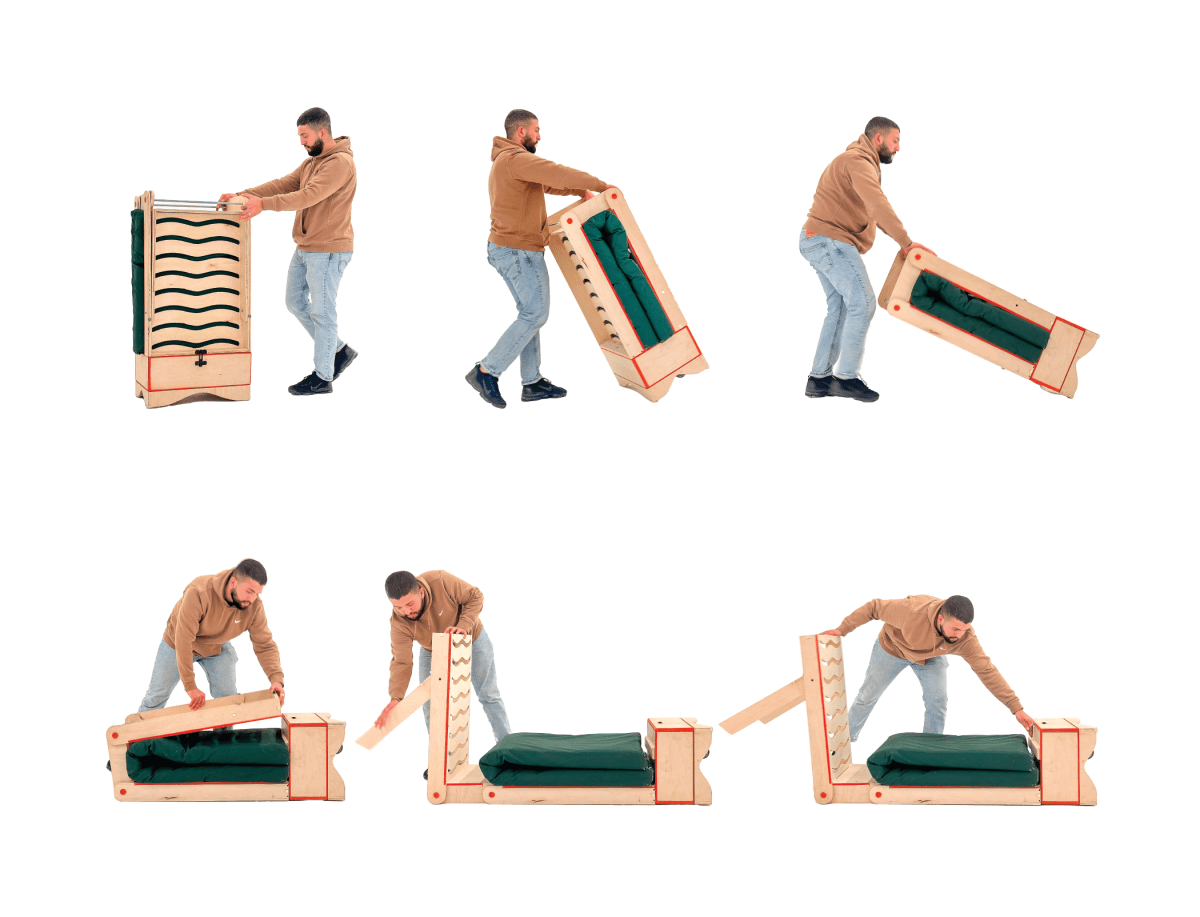
There was a long list of what “should” be done given the dire conditions at the shelter. The obvious needs of the families were overwhelming during initial visits, so the project scope was further defined by sorting must-have’s from nice-to-have’s. This process led to the decision to make 69 folding beds on wheels with storage compartments.
Community Workshop
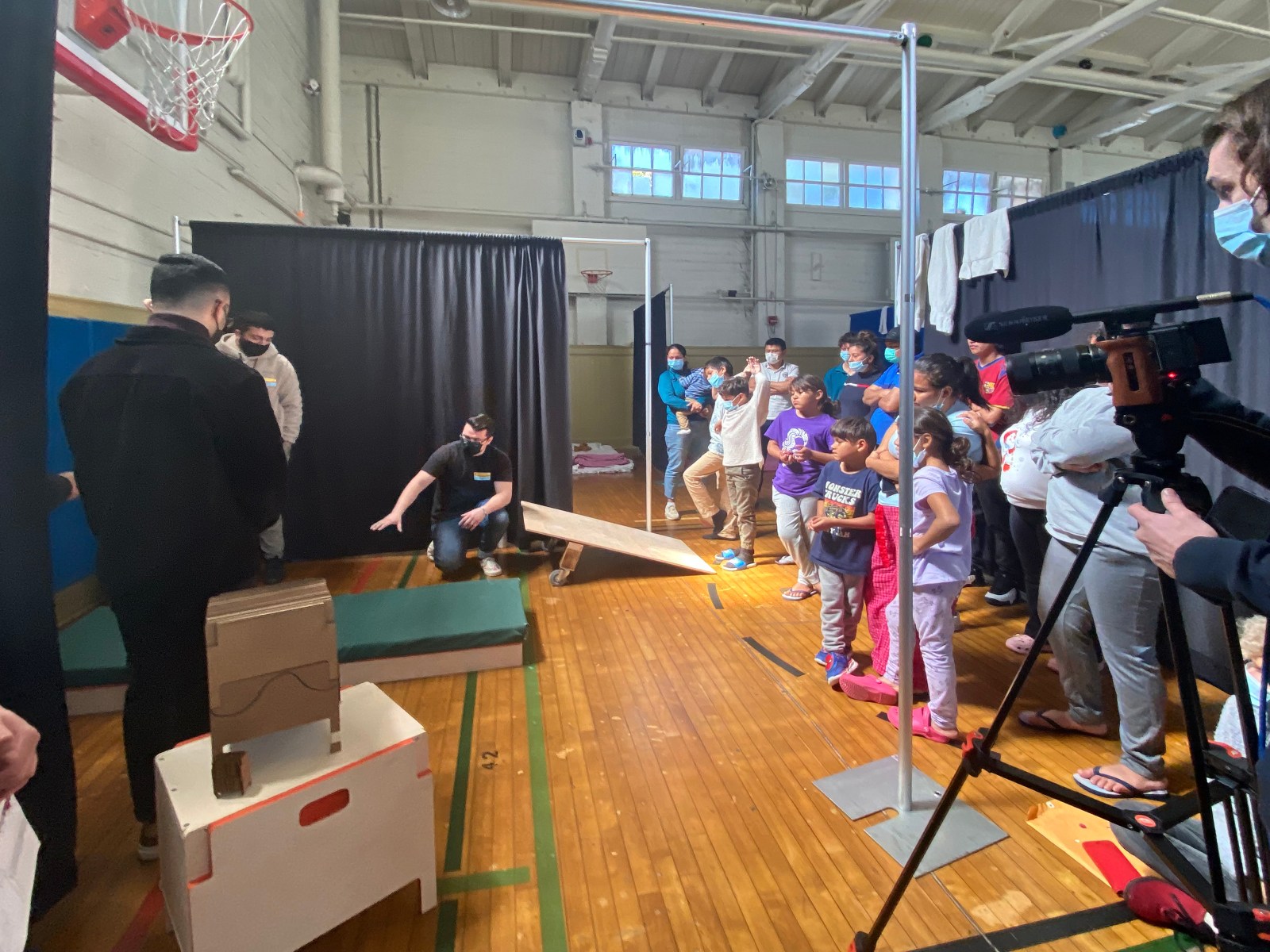
EMPOWERMENT THROUGH CO-CREATION Recognizing that levels of design literacy can create a power imbalance, full-scale prototypes were used to remove barriers to co-creation. Most of the families at the shelter were not English speakers which made the prototypes the most effective means for communication providing direct hands-on experience. Parents and children offered their design input by trying out the folding bed prototypes. Simulating the daily routine using the prototypes made it possible for the families to provide valuable design insights that could only come from “situated expertise of the people.”9 An example was a compartment for shoes in the folding bed which took up too much space in the suitcases.
Community WorkshopPrototype Testing during Community Workshop
To build trust with the families, and with DSCS, we documented our observations and presented design proposals as direct responses. Due to fluctuations in the shelter roster, it was critical to establish clear connections between feedback from families and design responses. This video footage captures how the prototypes engaged families during community workshops.
Prototype Testing during Community Workshop
PROTOTYPE AS EVALUATIVE TOOL We adapted Sanders and Stappers’ three approaches to codesigning, “cultural probes, generative toolkits, and prototypes,” to the realities of the family shelter. The “generative research phase” was abridged due to the unpredictability of participants. 10 The families stay for different durations at the shelter. In between workshops, separated by months, some families had left the shelter upon being placed in housing or they happened to be off-site for appointments. Documentation of previous workshop sessions provided continuity when there were no returning participants.
Mobile Folding Bed with Storage Compartments
EXPANDING DESIGN PRACTICES Co-creation is not new, but it should be more widely embraced as one approach to tackle systemic problems. Paired with micro-interventions, it can reach those who are furthest away from the design process. Humility is needed to develop a co-creation method that fully benefits from widely different lived experiences.
In addition, there must be room in the curriculum for developing skills that may not align with accreditation requirements. During the “fuzzy front end” phase when project scope is being determined, design skills should be used on behalf of the co-creation team to develop tools for exploration and expression.11 Knowledge of material costs and fabrication processes will be essential to assess budget and schedule feasibilities. An added reward in working with children is the opportunity to introduce them to careers in design.
Architecture students who develop co-creation skills can lead the change to include more people we advocate for in design processes.
Micro-Interventions from Past Years
STUDENT REFLECTIONS ON CO-CREATION The 69 folding beds are currently in production. Pausing to reflect on the past 8 months, students shared what they learned about co-creation:
Prototypes were compelling tools to communicate with the families. It was much more effective than diagrams. The cocreation process evealed that our assumption is not always correct. We are inexperienced in their situation. We are the tools that users need to craft their needs. (Mohamed Meawad)
Our objective was to empower the families, rekindle their sense of ownership in the use of the spaces, reestablish their visibility, and instill hope. (Andrew Hart)
Interacting with the families and getting to know them helped the project move forward. (Mazen Ghaly)
It was crucial to engage the families because they are experts in their own experiences and needs. They know the realities of living without a home and could offer valuable insights. Art and community-building activities help families feel connected to the design process. They gain a sense of control over the project’s direction and have a say in the decisions that affect their lives. When unsheltered families are seen as partners in the design process, it sends the message that homelessness is a societal challenge that we can all work together to address. (Kim Ebueng)
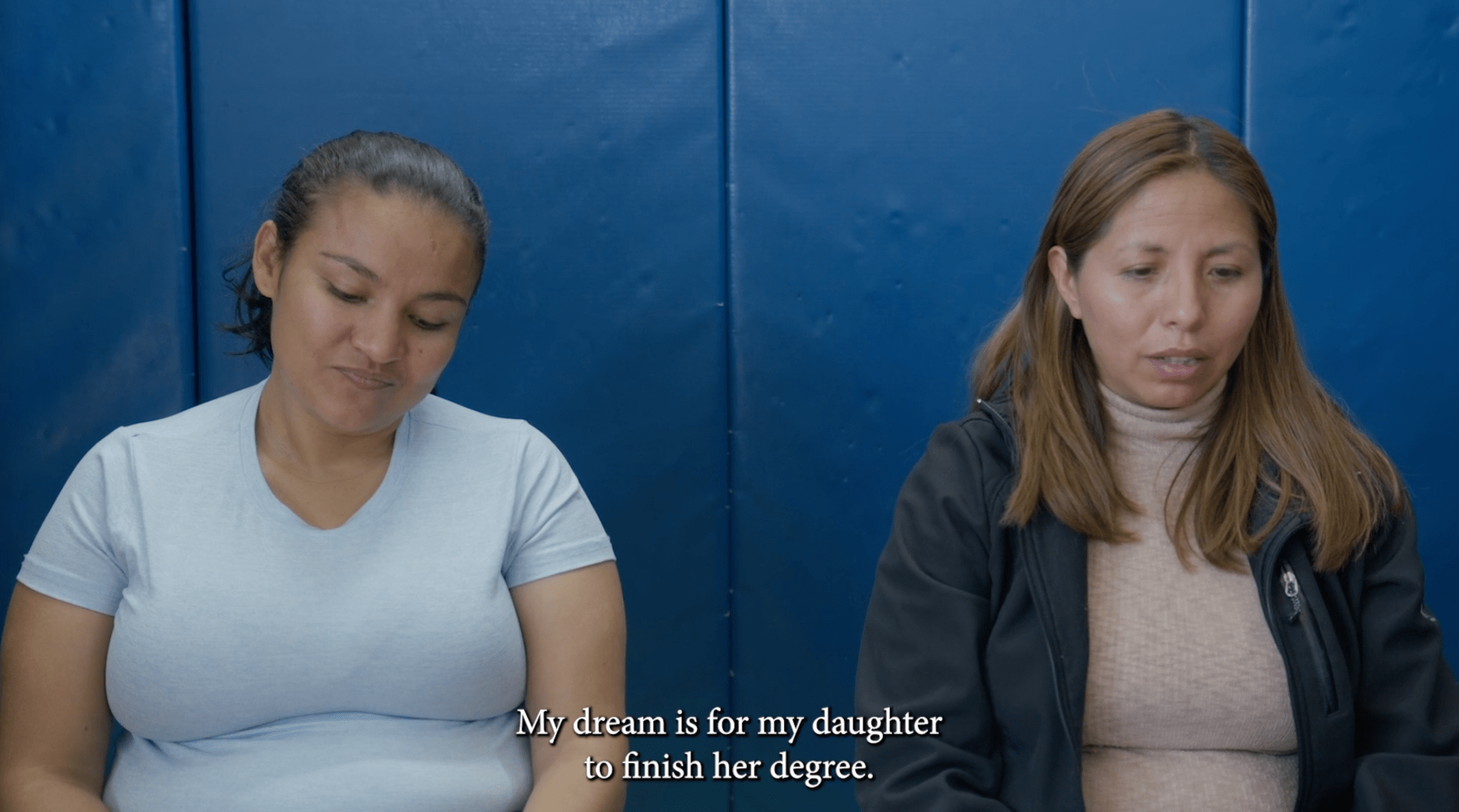
Stories of Stay Over Program Families
VIDEO STORYTELLING On a final note, we found video storytelling an effective way to build empathy for families experiencing homelessness. At its inception in 2018, the Stay Over Program was not without its critics. There was opposition stemming from negative stereotypes associated with homelessness. Despite the skepticism, DSCS and BVHM created the warm culture at SOP that is palpable to visitors today. We invited the families to share their stories in video interviews. Tragedies rendered them temporarily unhoused, but their hopes for their children connected us. The video stories we collected helped families feel heard and highlighted the compassion and hope that the SOP program provides.
9 Elizabeth B.-N. Sanders & Pieter Jan Stappers, “Co-Creation and the New Landscapes of Design,” CoDesign: International Journal of CoCreation in Design and the Arts, vol. 4, no. 1 (2008): 5-18, https://doi.org/10.1080/15710880701875068.
10 Elizabeth B.-N. Sanders & Pieter Jan Stappers, “Probes, Toolkits and Prototypes: Three Approaches to Making in Codesigning,” CoDesign: International Journal of CoCreation in Design and the Arts , vol. 10, no. 1 (2014): 5-14, http://dx.doi.org/10.1080/15710882.2014.888183.
11 Elizabeth B.-N. Sanders & Pieter Jan Stappers, “Co-Creation and the New Landscapes of Design,” CoDesign: International Journal of CoCreation in Design and the Arts, vol. 4, no. 1 (2008): 5-18, https://doi.org/10.1080/15710880701875068.
Balikbayan boxes were sent from the United States by my family back to the Philippines filled with goods and the idea of the American dream. These boxes are a manifestation of “coming home” of the Filipino diaspora and the actualization of my dreams.
“Wayfinding” is a place that guides immigrants to achieve their American dreams by forging their still evolving identities in the US. The center creates a platform for immigrants where they can get support in the formal immigration process and other areas of acculturation including language, culture, and employment while establishing relationships and connections in the local community of San Francisco.
Through the use of a patchwork of spaces throughout the building, the immigration process of assembling a new way of life is reflected. The language of layered transparency across the spatial patchwork provides personal and visual connections between spaces. Curved planes generate intimate spaces carved out from the layers of programs while embracing and leading users as they meander through the building.
*Balikbayan box is a carton shipped to the Philippines from another country by a Filipino who has been living overseas, typically containing items such as food, clothing, toys, and household products.
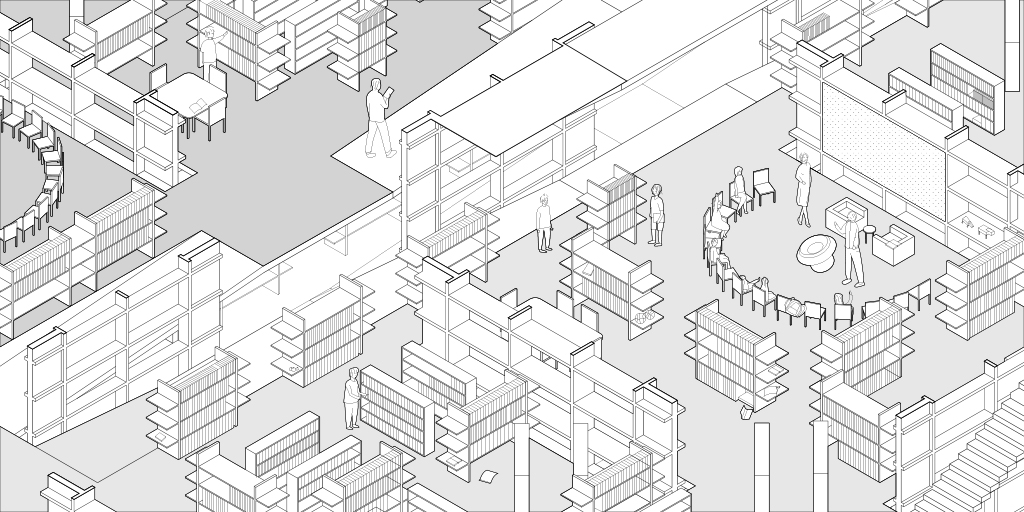
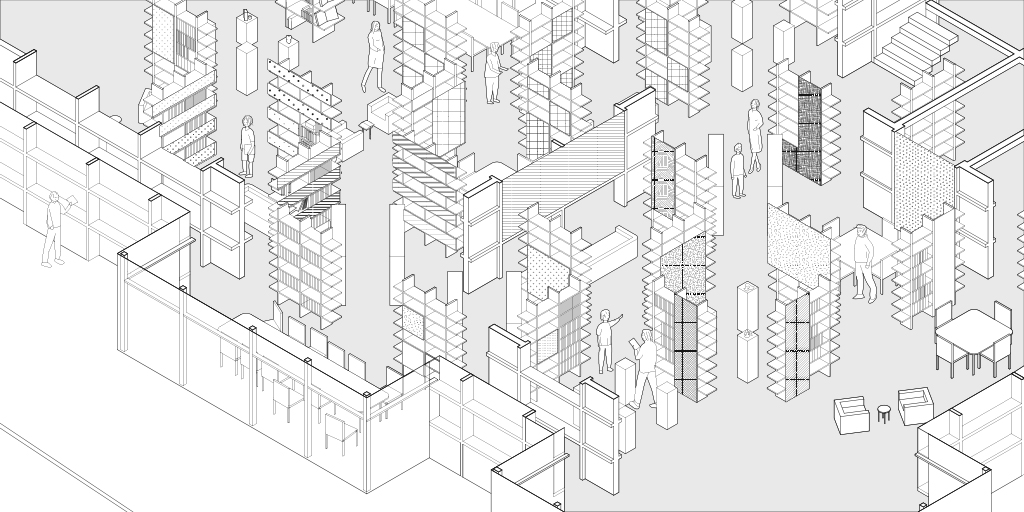
The proposal is called the Sanctuary of Narrative. It is a multi-media archive of San Francisco that functions as an educational facility for the local junior high and high school students and visiting humanities researchers. The primary purpose of the project is to offer a space of heuristic questioning, searching, and learning in an open and translucent field of information.
The Sanctuary of Narratives is an extension of local schools that houses a community of scholars who acknowledge the significance of youth development and methods of information-searching. It is where the youths are encouraged to question, challenge, search, record, and discuss about their families, schools, sexualities, churches, childhoods, adulthoods, and identities. It is a labyrinthian apparatus that curates, stores, produces knowledge and narratives that serve the curious next generation.
Architectural Description
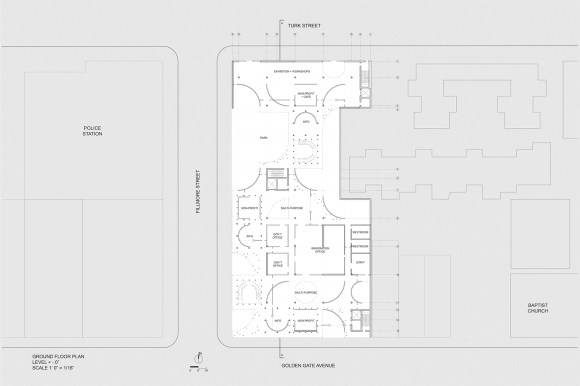
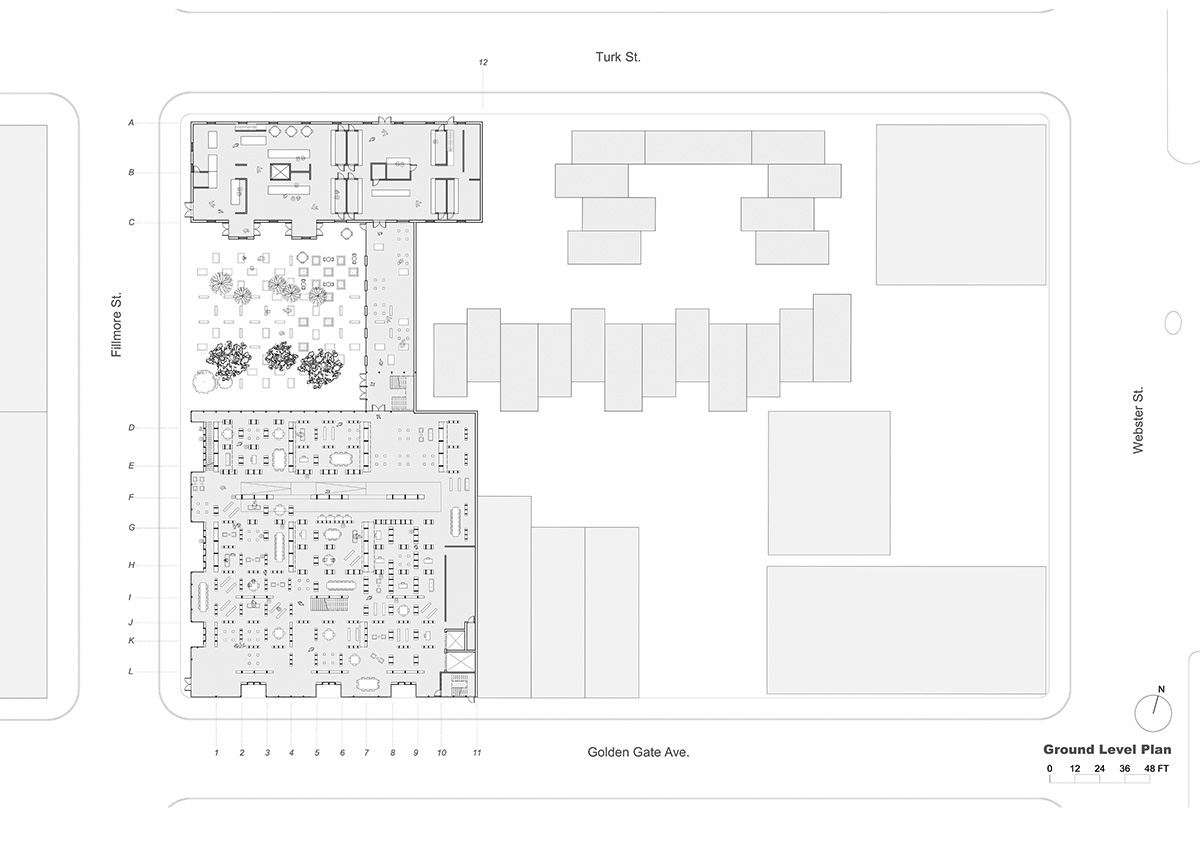
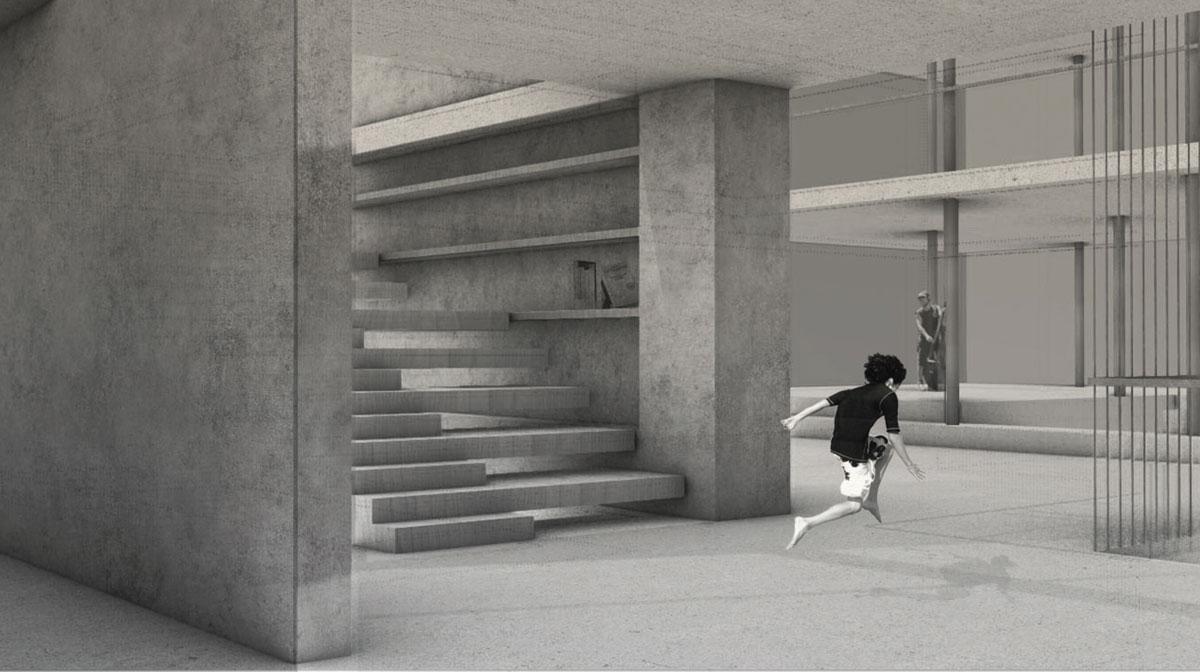
Sanctuary of Narrative is located in Fillmore St. and Golden Gate Ave. where a historically preserved power substation, a mini-urban park, and a fast-food restaurant are placed. Using the existing preservation as a new entrance and an activated retail-filled corridor, the visitors are led to an open field of bright space and curated archives where the students exhibit their learning outcomes.
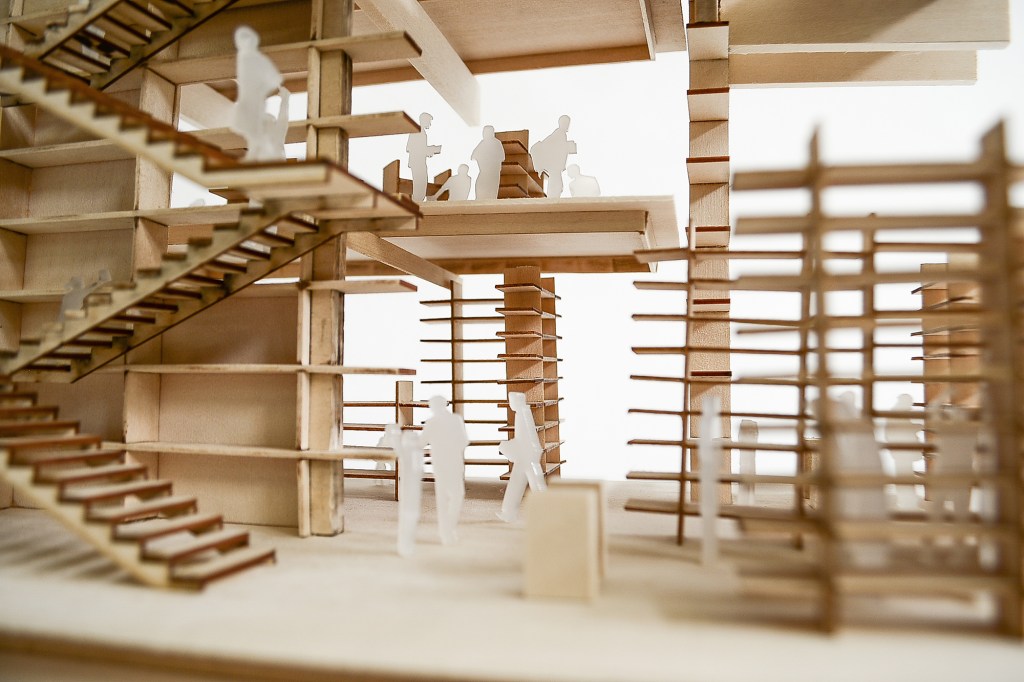
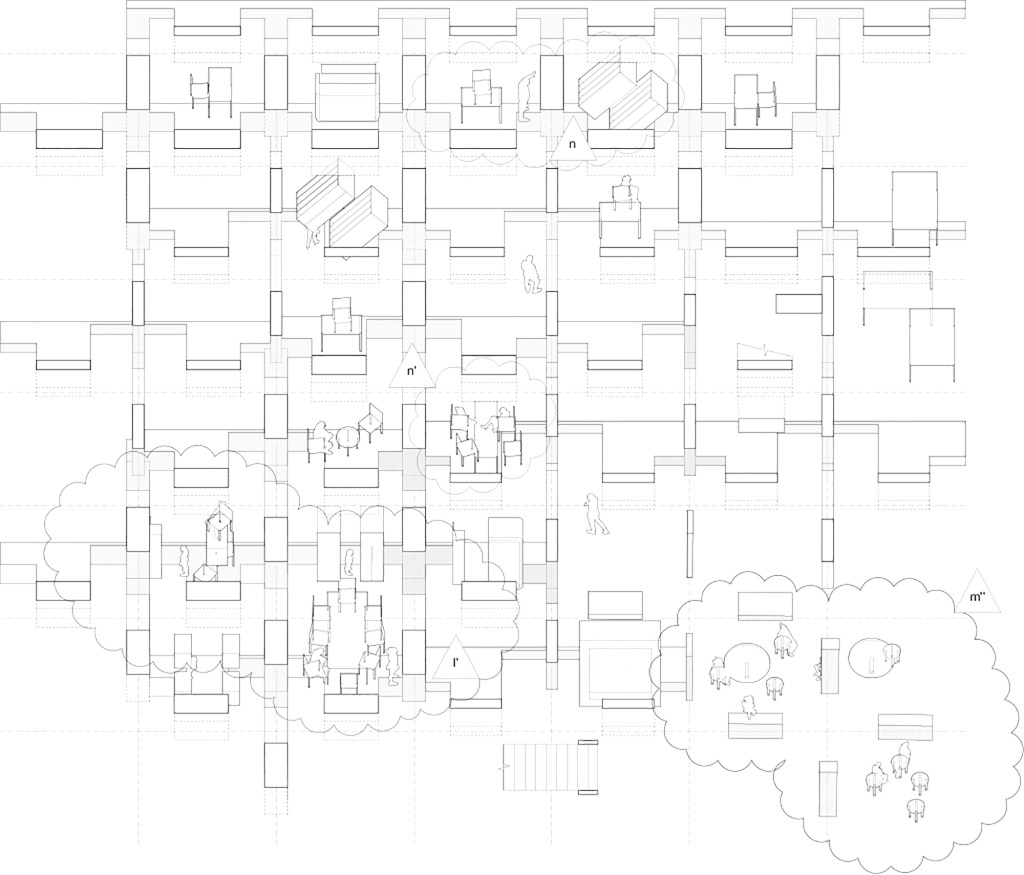
The upper levels serve various different archival programs and field of archives that are comprised of 12’x12’ grid-based modules. The modules act individually and collectively, depending on suggested activities such as individual learning, researching, discussing in groups, watching multi-media projections, or seeing curated objects. The archival programs are nested within the dissolved field of information and activities.
I am designing a building that would not only give a sense of belonging to individuals that have experienced pain but also to those who have had injustice done to them.
In researching the history of the African American population in the Fillmore District, I found there to be similarities to my life. During the Redevelopment period in the Fillmore, African Americans, who had created a thriving community, were forced to move to the East Bay or to entirely new cities. I grew up in a small country called Rwanda whose people suffered from a genocide in 1994 that took the lives of a million people. Rwandans had to re-orient themselves to the world after a disorienting loss. My generation came of age during this period and saw people struggle to heal but yet create a new community based on shared pain. Years later, after graduating from high school, I had the chance to move to the United States for university. I left a country where I was a part of this communal pain and learned to become an ‘international’ student in a country where I had to find new commonalities with those with a different history.
I have lived in many different cities by myself. I have faced many major changes in my life. And I have felt lost many times. Whenever I feel lost, I walk down the street without any purpose and let myself be immersed within the surrounding moments listening to the live street music. As an emotional experience, being immersed in these moments gives me inner strength and peace.
The main program of the building is a live music performance space for people who are struggling with their identities and getting lost in their lives. It is intended for two groups of people: those who want to stay in the U. S. but cannot and those who want to go back to their home countries but cannot. The program encourages people to be active while giving them the option to be at rest. It also creates opportunities for people to learn and be informed while interacting with others.
The mapping studies the site as a city grid and analyzes how the rigid grid influences urban development and people’s behaviors. Where do people feel comfortable standing, sitting, and gathering? I am also looking for unusual moments that are happening around the site. For example, where people make U-turns despite the fact that there is a No U-Turn sign, where people cross the street in the absence of a cross walk, where people park when there is a No Parking sign, etc. And how does this relate to the existing city grid in terms of the distribution of the retail, restaurant, and residential buildings, and how does it influence the density of the city?
The idea of the physical model is to explore the relationship between the grid and the unusual moments and to extract the condition of the spaces from them.
The building offers live music as therapy for displacement and architecture as an instrument of peace.
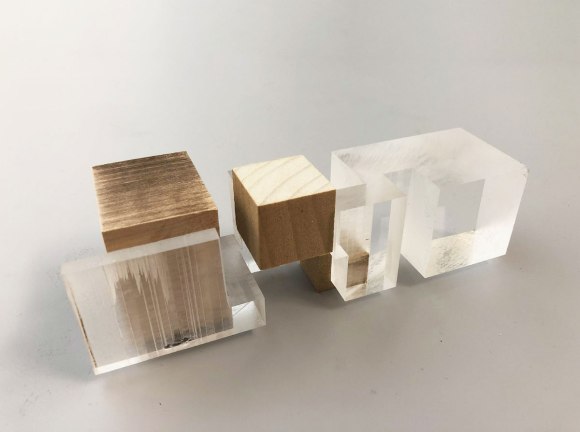
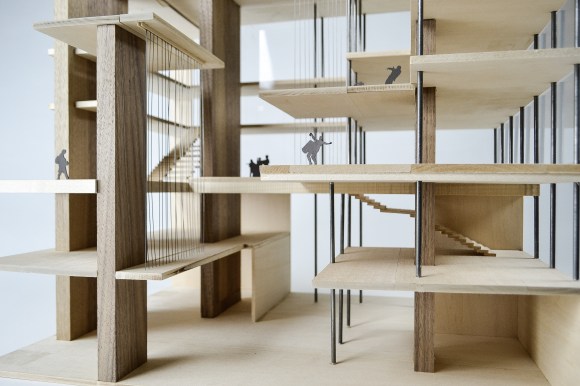
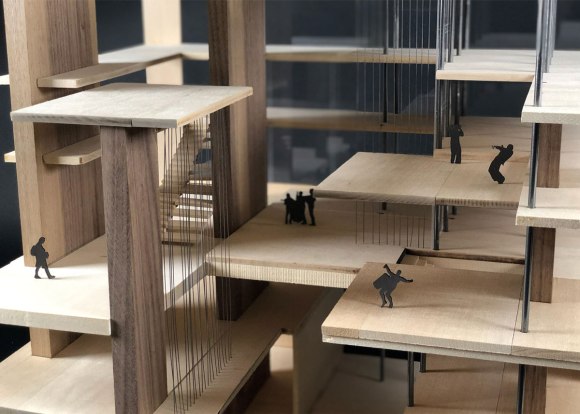
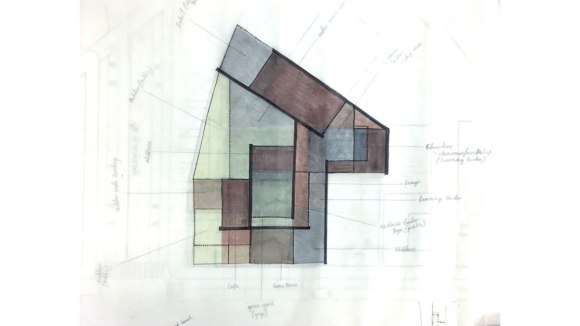
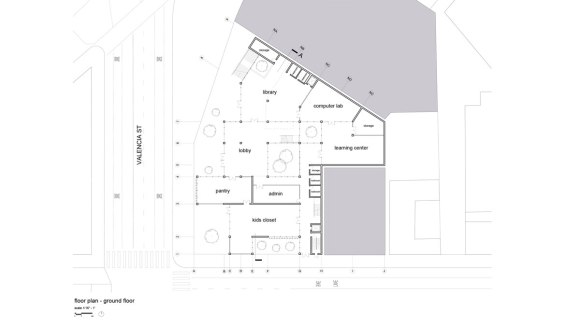
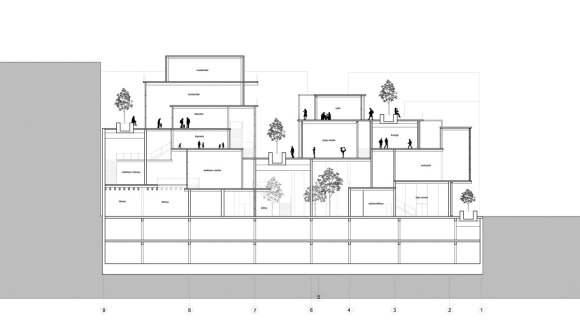
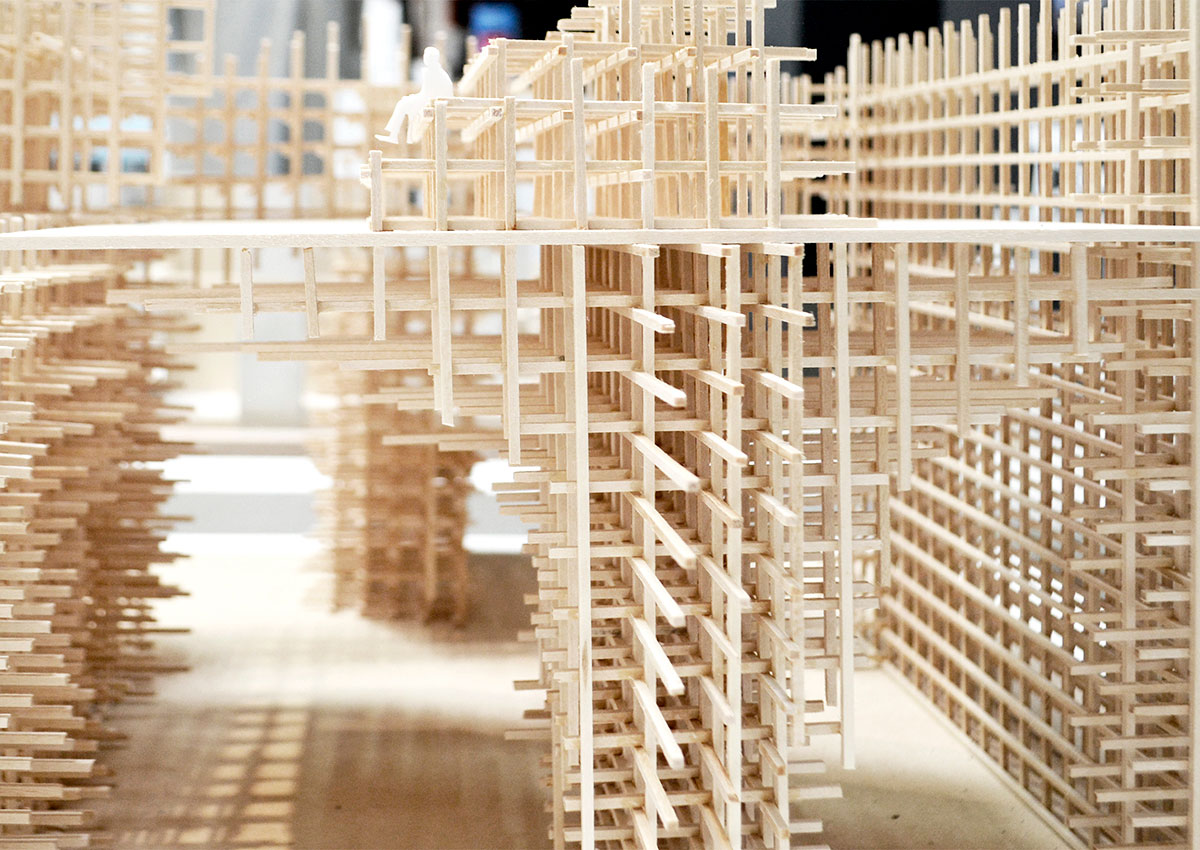
The Valencia Lighthouse is about offering a path towards hope for low-income communities in San Francisco. Through my research and my own personal experiences, I focused the project on creating a program that works as a support system for families. The design stemmed from my mapping, where I mapped out community resources and realized many community resources rely on each other in order to survive. Taking this dependence concept, I explored this through the process of model making, where the basswood became the depending structure and the offset surfaces became ways for allowing light to pass through spaces. I developed a language where spaces are housed within translucent and transparent walls, where screens define special boundaries and where volumes intersect and overlap each other. Using this language in the design, offered beneficial characteristics for the user group. Allowing views of people and activities from the exterior inviting people in. Volumes of space offset and intersect maximizing views from the interior into other spaces and out, allowing natural light to filter into each space.
The program consists of a viewing gallery as well as a school where tourists and film & photography students can mingle so that tourists get a glimpse of how students create their work.
The tourist aspect came from my personal narrative of traveling and having the opportunity to see various landmarks. Tourists typically get a highly curated perception of how San Francisco wants to be seen through their iconic landmarks. But someone that lives in San Francisco gets a unique perspective as there are hidden gems around the city that one can stumble upon. The Film & Photography School in my vision allows for the tourist to understand how others see the world.
A mapping of landmarks in San Francisco generated a formal language which was further explored in the notational models. The concept of framing in the architectural language created directionality in the way user-groups moved through space. The play between the directed views and movements through the use of frames introduces the varying perspectives and perceptions of other people in the building.
The concept of framing was further inspired by the camera which allows for multi-perspectival views of events. The visitors are invited to construct their own views of the city of San Francisco. The use of frames encourages the visitors to appreciate a different way of seeing their surroundings.
This course posits new ways to inhabit large urban structures through a process-driven methodology. By challenging type-driven formulaic structural responses, conflicts between architectural priorities and structural efficiencies are celebrated as the starting point of a dialogue that instigates structural adaptations creating rich tectonic expressions, complex spatial configurations, new program relationships.
When structural design lacks integration with architecture, the structural design criteria become largely dependent on efficiencies in cost and construction. The studio projects reinforce the concept of an efficiency that encourages resiliency through tectonic adaptation. This efficiency is understood to exist within a much longer time frame where the expression of the building is both integrative and timeless.
If we posit that architecture is to fulfill a need beyond structural stability and cost-effectiveness in construction, then the integration between architecture and structure points towards a different relationship in which the two disciplines engage in a dialogue. Founded on critical analyses of prevalent formulaic structural solutions, a productive dialogue is one in which there are meaningful conflicts that must be resolved. The students identify sources of conflict in order to develop an adaptable structural system. The metric by which resilience is measured is informed by the degree to which the integration between architecture and structure is successful in creating a trigger for a rich tectonic expression that adapts to conditions and needs while at the same time fulfilling the responsibilities of structural stability and efficiency.
Taken concurrently with ARH 410 Studio 7, in this course structural intuition is cultivated through physical model making to evaluate and propose structural systems for design studio projects. The relationship between structural behaviors and building geometry is studied through load tests and load path diagrams to establish design criteria for structural systems.
Architects collaborate with structural engineers in the design of buildings. For this collaboration to be successful it is important for architects to cultivate an intuitive sense of how building structures behave. We will develop structural intuition through load testing physical models and making careful observations. Structural design this semester will aspire towards a close integration with architecture. A clear architectural design intent and an open-mindedness for inventive structural systems are the necessary ingredients for a meaningful integration. When structural design is approached as an architectural design opportunity, rather than as a restriction on design freedom, compelling and rigorous design proposals will follow. Grounded in a critique of prevalent contemporary structural systems, we will explore and experiment with creating conditional rules for structural behaviors to invent new structural systems.
Our goal this semester is to integrate the architectural design intent with the structural solution. The structural proposal will be uniquely adapted to the architectural studio project. In other words, the structural proposal will not be one that is generic. To this end, we will actively seek to create a structural problem. The presence of a structural problem in your project is a good litmus test for the integration.
Constraints make better design. For this reason, the competing design criteria between architecture and structure is welcomed in this class. The negotiation and compromise that must happen to reconcile the competing priorities is what we refer to as the integration between architecture and structure, our goal.






























 karen seong architect